A global aviation hub with terminals, transit flows, parking, retail and multi-level passenger movement.
Demonstrates relevance in high-density, multi-zone environments where outdoor GPS cannot carry the full journey.
Deployment Proof
The underlying technology associated with Inkwater's Last-Meter Positioning thesis has been deployed in environments where density, vertical structure and signal obstruction make positioning difficult.
Known Environments
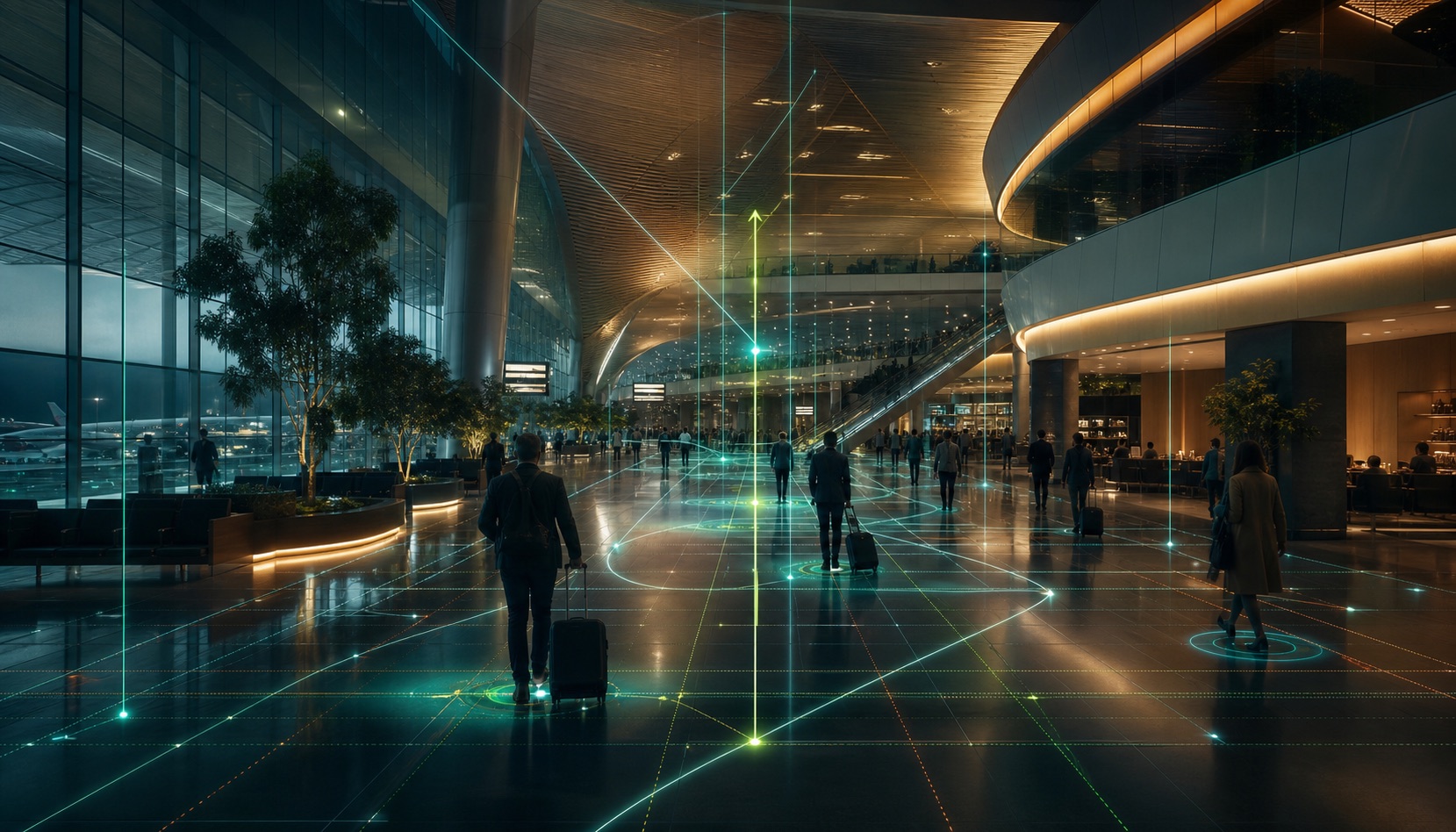
Demonstrates relevance in high-density, multi-zone environments where outdoor GPS cannot carry the full journey.
Highlights the need for floor-level and path-aware positioning in stations where a wrong level can be as disruptive as a wrong coordinate.
Shows the commercial potential of a positioning layer that can scale across complex buildings without a heavy beacon-first model.
What These Sites Prove
These environments matter because they combine the conditions that usually break simple location systems: dense movement, obstructed signals, multi-level paths and operational pressure.
High-density pedestrian movement
Indoor and underground signal obstruction
Multi-level X/Y/Z spatial context
Parking-to-building continuity
Venue-scale operations
Real-world optimization loops
Video References
Potential buyers and strategic partners can review selected deployment reference videos in the language most relevant to their decision team.
Reference videos for a major commercial complex environment, available in Traditional Chinese, Simplified Chinese, Japanese and English.
Reference videos for a complex, high-density transit environment, available in Traditional Chinese, Simplified Chinese, Japanese and English.
From Proof to Scale
Inkwater's commercialization path is to translate complex-site deployment knowledge into repeatable partnership models for operators, platforms and intelligent machines that need positioning continuity beyond GPS.
Deployment Discussion
Contact the Inkwater team for venue, infrastructure, robotics, mobility or safety deployment conversations.